Random number generator
Pick a range, tap Draw, and watch the reels land on your number.
Between 1 and 100
No number drawn yet.
Tap Draw, or press Space
Range
Last draws
None yet. Your draws line up here, newest first.
- Free, no sign-up
- The result is drawn before anything moves
- Nothing leaves your browser
What it does
Set a minimum and a maximum, tap Draw, and this random number generator (RNG) picks a whole number between them, both ends included. Every number has the same chance: your browser’s secure random generator draws it before the reels start turning. Draw up to 50 numbers at once, with or without repeats.
How to use it
- Set the range. Type a minimum and a maximum, or tap a quick range like 1 to 100. Negative numbers work.
- Tap Draw, or press Space or Enter. The reels stop left to right on your number.
- Need more than one? Set How many, up to 50, and turn on No repeats so they all differ.
- Tap Copy to paste your numbers anywhere.
What people use it for
Raffles and giveaways
Number the tickets or the entries and draw. With No repeats on, nobody wins twice.
In class
Give every student a number and draw who answers next, or pick a random page to read aloud.
Games
Guess the number, settle who goes first, or stand in for a lost die with 1 to 6.
Spot checks
Pick 20 rows out of 1000 to check by hand. No repeats and Sort give you a tidy list to copy.
Small decisions
Number your options and let the draw choose. Each one has the same chance, so nobody can argue.
True random or pseudo-random?
A computer follows instructions, so on its own it cannot do anything by chance. There are two ways round that.
- True random numbers come from a physical process nobody can predict, such as electrical noise in a circuit, measured by hardware.
- Pseudo-random numbers come from an algorithm that turns a starting value, the seed, into a long run of numbers that look random. The same seed gives the same run.
This page uses crypto.getRandomValues, the generator browsers provide for security work such as encryption keys. It is pseudo-random, but the strongest kind: a cryptographically secure generator, seeded from your operating system’s pool of unpredictable hardware events, and built so that nobody can work out the next number even after seeing millions of earlier ones. For picking numbers fairly, that is as good as true random. It does not use Math.random(), which is quick but makes no such promise.
Your numbers are drawn on your device and are not sent anywhere.
Why numbers repeat sooner than you think
Draw from 1 to 100 a few times and the same number turns up again surprisingly early. It is the birthday problem: in a room of 23 people, two of them probably share a birthday. Every new draw has more earlier numbers it could match.
| Range | Repeat likely by | Chance |
|---|---|---|
| 1 to 10 | draw 5 | 69.8% |
| 1 to 100 | draw 13 | 55.7% |
| 1 to 1,000 | draw 38 | 50.9% |
| 1 to 1,000,000 | draw 1,178 | 50.0% |
Each single draw is still fair: from 1 to 100, any number has a 1 in 100 chance every time, whatever came before. If every number in a draw must be different, turn on No repeats.
How it picks
The way the RandALL app does it: the number first, the reels after.
- Your range is read. Whole numbers up to 15 digits, negative or positive. A range typed backwards is turned round, so 100 to 1 means 1 to 100. Both ends can come up.
- The number is drawn first. For a range of n numbers, a whole number from 0 to n minus 1 is drawn with
crypto.getRandomValuesand added to your minimum. Rejection sampling throws away the few raw 32-bit values that would give some numbers an extra share, so each one has exactly a 1 in n chance. - Wide ranges get more bits. One 32-bit draw covers 4,294,967,296 numbers. For a wider range, two draws are joined into a number with just enough bits for it, and anything past the end is drawn again. No remainders, no rounding.
- No repeats is a fair set, then a shuffle. Floyd’s algorithm picks numbers that all differ, with every possible set equally likely, and a shuffle makes every order equally likely too.
- Then the reels turn. Each reel steps through the digits before its own, slowing as it goes, and they stop left to right, as in the app. They only show a number that is already decided.
Tested. In 100,000 test draws each from 1 to 10, 1 to 6 and minus 3 to 3, every number came up evenly (chi-square test). A range three times wider than 32 bits and the full 15-digit range split evenly into slices, odds and evens, and last digits. With No repeats no draw ever repeated, and all 20 ordered pairs from 1 to 5 and all 20 sets of three from 1 to 6 came up evenly.
More random tools
Questions
Is this random number generator really random?
As random as a computer gets without special hardware. Each number comes from crypto.getRandomValues, the secure generator browsers use for encryption, and rejection sampling keeps every number in your range exactly equally likely. The number is drawn before the reels move.
How do I pick a random number between 1 and 100?
Type 1 as the minimum and 100 as the maximum, or tap the 1 to 100 chip, then tap Draw. Both ends count, so 1 and 100 can come up. There is also a ready page for 1 to 100.
Can I generate random numbers without repeats?
Yes. Set How many to the count you need, up to 50, and turn on No repeats. Every number in that draw is then different. Turn on Sort to list them smallest first, and tap Copy to paste them anywhere.
Can I use negative numbers or very large ones?
Yes. The minimum and the maximum can each be any whole number up to 15 digits, positive or negative, so minus 50 to 50 works, and so does 1 to 999,999,999,999,999. Every number in the range has the same chance, however wide it is.
Why did I get the same number twice in a row?
Because every draw starts fresh. From 1 to 10 the chance of the same number twice in a row is 1 in 10, and a repeat somewhere in your first 5 draws is more likely than not (69.8%). To rule repeats out within one draw, turn on No repeats.
What does RNG stand for?
Random number generator: anything that produces numbers by chance, from a die to the code that shuffles a playlist. This page is an RNG for any range you type.
Is there a random number app for iPhone?
Yes, RandALL. Its Number tool lands each number on spinning reels with a haptic knock, shows where it fell in your range, and draws again when you shake your phone. Your first 24 hours are free, with every tool.

Take it with you
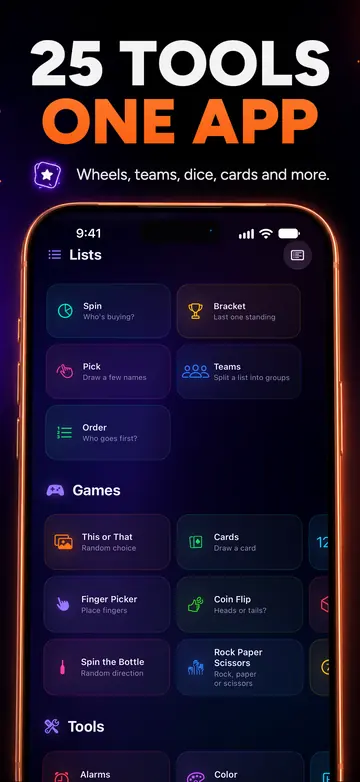
RandALL for iPhone has 25 tools in one app: wheels and teams, real 3D dice, random alarms, Finger Picker and more. It works offline.
Your first 24 hours are free, with every tool. After that, subscribe or buy the lifetime unlock once. Family Sharing included.
Get it on the App StoreiPhone only for now. These web tools are yours to keep using.